
Instrumental Analysis Laboratories
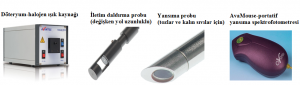
Device: Avantes AvantesAvaSpec-2048
Fiber Optic UVvis Spectroscopy device is used to measure light intensity in UV-VIS-NIR and IR-region.
There are light transmission immersion probe, replaceable tip reflection probe and portable handheld spectrometer (AvaMouse) that can be used with the device.
The light transmission immersion probe is used to obtain time-dependent or direct absorbance measurements in liquids, while the interchangeable tip reflection probe is used to obtain spectral information about powders or dense liquids.
The portable handheld spectrometer (AvaMouse) is used to determine the color of flat surfaces by making reflection measurements in the visible region.
Technicial Specifications:
Wavelength range: 200-800 nm (UV/VIS),
Temperature range: -40-100 °C (conduction immersion probe), -30-100 °C (reflection probe), room temperature (avamouse)
Applications:
It is used in many different applications such as color measurement, determination of the concentration of chemical compounds or electromagnetic radiation analysis.
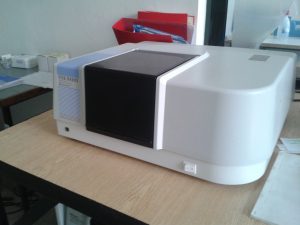
Device : Shimadzu IRPrestige-21 FTIR-8400S
Infrared (IR) absorption spectroscopy is a type of vibrational spectroscopy; IR rays are absorbed by the vibrational movements of the molecule. In mathematical Fourier transform spectroscopy, the luminous intensity is taken as a function of time. Fast and high resolution spectra can be obtained without the need to scan each wavelength separately. With this method, molecular bond characterization is done; The functional groups in the structure of solid, liquid, gaseous or solution organic compounds, whether the two compounds are the same, the state of the bonds in the structure, the bonding sites and whether the structure is aromatic or aliphatic can be determined.
Technicial Specifications :
Michelson interferometer
Single beam optics
Germanium coated KBr beam splitter
High sensitivity pyroelectric detector(DLATGS)
wavelength range of 7800 cm-1- 350cm-1
Applications :
It is used to determine the functional groups in the structure of solid, liquid, gaseous or solution organic compounds.
Device Usage Form: FTIR ANALYSIS TRACKING FORM
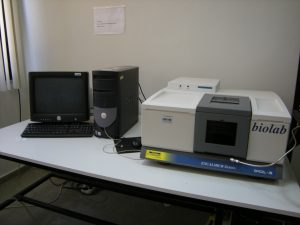
Device: Digilab Excalibur Series
FT-IR is used to examine molecular structure and interactions. Adsorption and desorption studies can be applied under vacuum with a temperature-controlled drift cell. It is used in the analysis of many substances such as polymer films, fibers, water, proteins, low molecular weight hydrocarbons, agriculture, food and petroleum products.
Applications:
Fourier Transform Infrared Spectrometer ( DIGILAB EXCALIBUR ) is a device used in studies in many fields such as chemistry, pharmacy, biology, food, geology and environment.
Device Usage Form: analysis tracking form
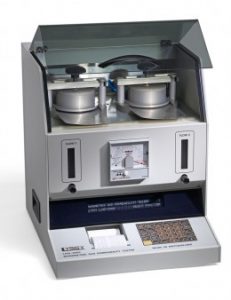
Device: Lyssy L100-5000 Manometric
Gas Permeability Analyzer (Lyssy L100-5000 Monometric) is used to measure the permeability of films or foils to any general gas or gas mixtures. This device tests gas permeability using the most well-known manometric principle—the pressure variation of the gas passing over the film.
Technicial Specifications :
Temperature range: 5-75 °C
Measuring range: 1 – 10,000 ml/m2/day
Sample size: 100mm X 100mm
Gas: Oxygen and carbon dioxide
Applications:
Food packaging films, paper coating applications, various polymeric membrane films
Device Usage Form: GAS PERMEABILITY MEASURING DEVICE ANALYSIS REQUEST FORM
Device: Haake Mars II
The rotary rheometer system is used to measure the response of the fluid to applied forces when viscosity measurements are not sufficient to determine flow properties and more parameters need to be determined and measured.
Technicial Specifications :
Temperature range (Peltier controlled cone and plate unit): -60°C to 185 °C
Minimum torque: 0.05 µNm
Motor inertia: 10 µNms2
Minimum oscillation frequency: 10-5 Hz
Minimum angular velocity: min-1 10-7
Applications :
Measurements of steady-state slip and dynamic slip can be performed to understand the flow properties of semi-solids, suspensions, emulsions, and polymers in industries such as pharmaceutical, food, cosmetics, and consumer products.
Device Usage Form: Rheometer-Analysis-FOLLOW-UP-FORM
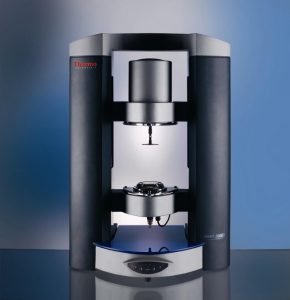
Device : MICROMERITICS AutoChem II 2920
The Chemical Sorption (Autochem II 2920) device provides information on the physical properties of catalysts, catalyst supports and other materials. It determines the catalytic properties such as metal distribution, active metal area, acid strength, surface acidity, distribution of strengths of active centers. It performs Pulse Chemisorption, Temperature Programmed Reduction (TPR), desorption (TPD), oxidation (TPO) and reaction analysis.
Measurements can be made on powder and particulate solids. The samples must be pre-warmed to be free of water and moisture. Approximately 1g of sample should be provided for measurement.
Technicial Specifications :
Oven Temperature max : 800 C
Gas: Argon, Helium, Hydrogen, Ammonia,
Applications :
Catalysts; TPR, TPD, TPO measurements
Device Usage Form : Chemisorp-Analysis-Request Form
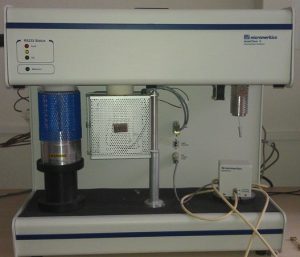
THERMAL GRAVIMETRIC ANALYSIS DEVICES (TGA)
Shimadzu TGA-51
Device Usage Form : thermal analysis form
| Shimadzu | ||
| Max Temperature | 1000 °C | |
| Sample Weight | 10 mg | |
| Atmosphere | Dry air or Nitrogen |
Applications :
Mass loss in solids and solvents
Determination of Deterioration Temperature
Adsorption/release
Corrosion
Sublimation
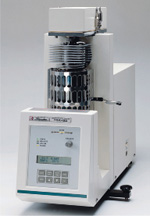
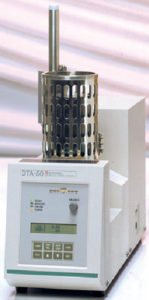
DIFFERENTIAL SCANNING CALORIMETER (DSC)
DSC measures transitions in material as a function of temperature and time in a controlled atmosphere environment. These transitions depend on the observed temperature and heat fluxes. These measurements provide quantitative and qualitative information about physical and chemical changes, including endothermic, exothermic, and changes in heat capacity.
| Temperature Range | Room Temp.-725 °C -150 to 300 C (with liquid nitrogen unit) |
| Heat Flow Range | ±0.01 ile ± 100.0 mW |
| Heating Rate | 1-50 °C/min. |
| Atmosphere | Nitrogen and Helium |
| Cooling water flow | 300 ml/min |
Our devices :
Perkin Elmer Lambda 25 UV-Vis Spectrophotometer
UV-VIS Spectroscopy ; It is used to identify unknown substances in solution and to determine the concentration of known substances. Ultraviolet (100-400nm) and visible light (400-700nm) (UV-VIS) absorption spectroscopy is the measurement of the attenuation of a beam of light after it has passed through a sample or is reflected from a sample surface. A decrease in the intensity of light indicates an increase in absorption. Many molecules absorb UV or Vis wavelengths, and different molecules absorb different wavelengths. An absorption spectrum consists of many absorption bands that show the structure of the molecule.
Technicial Specifications :
Wavelength range: 190-1100 nm
Optics: Dual beam.
Band gap: Lambda 25 (1nm fixed )
Light Source: Deuterium and tungsten lamps.
Scope of application :
Drinking water and waste water analysis
Pharmaceutical applications
Biochemical applications
Sample Delivery Terms :
Samples in solution should be clear and sufficient amount of solvent to be used as a blank should be brought.
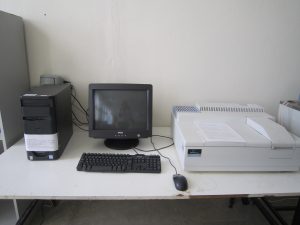
Device : PERMATRAN-W® Model 3/33
The water vapor permeability measurement device is used to determine the standard water vapor transmission rates of plastic films and packaging materials.
Technicial Specifications :
Temperature range: 5-50 °C
Measuring range: 0.005-1000 g/m2/day
Sample size: 5 cm2 (masking in highly permeable films) or 50 cm2
Humidity range: 100% and 5-95% RH
Applications :
The water vapor transmission rate (WVTR) test system is designed to evaluate barrier materials used in packaging applications.
Device Usage Form : WATER VAPOR PERMEABILITY MEASURING DEVICE ANALYSIS REQUEST FORM
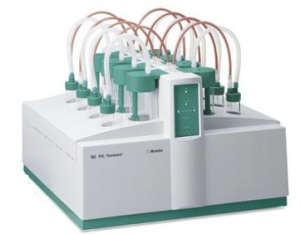
Device : Metrohm 763 Thermomat
PVC thermal stability meter is a special device used to determine thermal stability by using conductivity for the detection of HCl gas. Determining the thermal stability of PVC-chlorinated plastics is a three-step process. PVC decomposes at high temperatures and HCl gas is released when it decomposes. The HCl gas is carried by the inert nitrogen flow by the measuring cell filled with distilled water.
Technicial Specifications :
Temperature range: 50-220 °C
Conductivity measurement range: 0 – 500 µS/cm
Sample weight: 0.5 g (samples should be cut into small pieces if not powder)
Applications :
The thermal stability of PVC materials is measured by measuring the conductivity of the aqueous HCl solution.
Instrument : Perkin Elmer LS-55 Fluorescence Spectrometers
Fluorescence spectroscopy detects concentrations as low as one-trillionth (nano-level). Luminescence can be measured directly, small emission can be amplified many times with little noise. Selectivity for two selectable wavelengths (excitation and emission) and a multidimensional information can be obtained in fluorescence spectrometry scanning.
Emission of metal complex ions with fluorescence can be measured. Fluorometic analysis has numerous applications to organic and biochemical species. The most important applications of fluorometer are food products, medicine, clinical samples, cell biology, cellular toxicity/viability, molecular toxicity, protein folding/unfolding, receptor (simple experiments, DNS teaching, binding studies, and protein measurement), research (assay development, cell-based study), apoptosis studies, and analyzes of phagocytosis / oxidative processes.
Device Usage Form : FLORESSANCE SPECTROSCOPY ANALYSIS REQUEST FORM